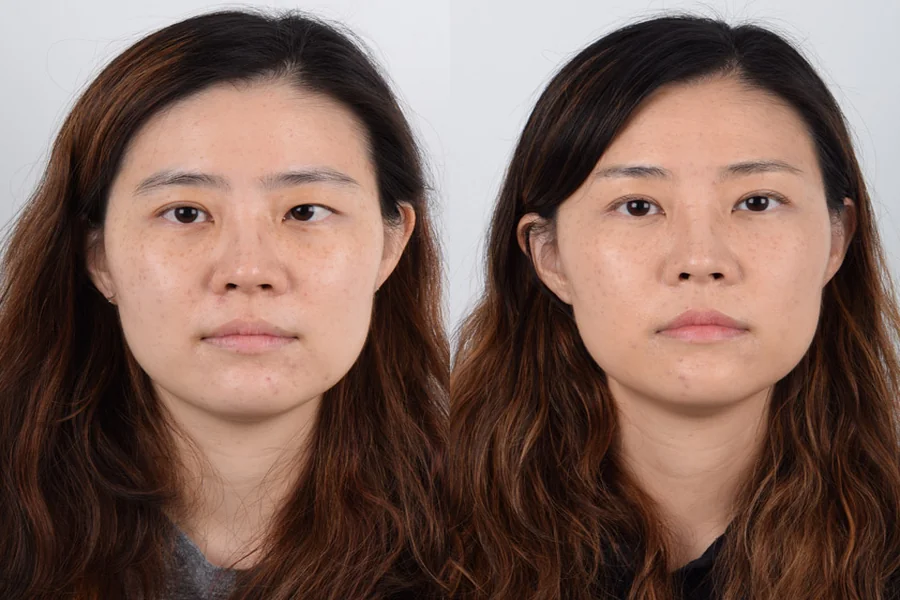
Our everyday life requires us to deal with people face-to-face. Having unilateral ptosis, a condition where one eyelid droops lower than the other, can make you appear exhausted or sleepy. Looking past aesthetics, one-sided ptosis also affects your ability to properly function. A droopy eyelid can cause chronic strain to your brows from constantly overworking the muscles of your forehead to pull back your heavy lid to be able to see better. It can also block your superior visual field.
For some people, the uneven shape of their eyes hits their self confidence negatively. Hence, they search for ways to correct this facial asymmetry, leading them to find a reputable plastic surgery clinic in Singapore to explore treatment options.
Fortunately, there are various ophthalmic plastic and reconstructive procedures available that can provide accurate and reliable interventions to restore balance to the eyes.
One-Sided Ptosis: Understanding Facial Asymmetry, Eyelid Imbalance and Its Causes
An aesthetically harmonious face is associated with having symmetrical facial features. A slight imbalance, such as with the height of your eyelids, can change expressions. Human faces are, by nature, rarely completely symmetrical. However, a distinct difference between your eyelids can focus attention on your eyes.
Unilateral or one-sided ptosis is a condition that develops when your eyelid’s levator palpebrae superioris muscle, also known as the muscle that does the lifting of your upper eyelid, becomes detached, stretched, or weakened on one side. This can be caused by several factors:
- Age-related or involutional ptosis: The most common cause of ptosis. This happens when the levator tendon separates or stretches from the tarsal plate as a result of decades of blinking and natural tissue laxity.
- Aponeurotic or mechanical factors: This can occur from constant eye rubbing, previous eye procedures or surgeries, swelling, or long-term use of contact lens.
- Congenital factors: This condition exists from birth as a result of the poor development of the levator muscle.
- Myogenic or neurogenic conditions: These are caused by rare muscle or underlying nerve conditions that affect the movement of your eyelids.
The asymmetrical appearance of your eyes become more prominent when a single eyelid hangs lower as it makes the affected eye look smaller, which makes it “lazy-looking.” Regardless of your energy levels or actual mood, this can make you look disinterested, sad, or perpetually tired.
In professional and social environments across Singapore, your first impression can leave a lasting impact on the people that you meet. Having this asymmetry can hurt your self assurance. If you have this condition for a long time, you may have developed the habit of avoiding direct eye contact, constantly raising your eyebrows, or tilting your chin upwards to better see a person you are having a conversation with. Setting a consultation with a qualified specialist at a licensed plastic surgery clinic in Singapore is the first step that you can easily take toward understanding the underlying structural cause of your ptosis and knowing the different options available to correct this condition.
Marginal Reflex Distance (MRD): The Diagnostic Precision
Obtaining eyes that look naturally symmetrical is both an art and a science. Plastic surgeons and oculoplastic specialists do not only depend on visual estimations when they assess ptosis symptoms. They utilise the gold standard in measuring and evaluating eyelid positions, called Marginal Reflex Distance (MRD).
What is Marginal Reflex Distance (MRD)?
MRD-1 takes the measurement of the vertical range from the corneal light reflex’s center (the reflection of a light source on your pupil) to the margin of your upper eyelid when you are gazing straight ahead. A healthy and normal range of MRD-1 measures between 4.0 to 5.0 mm. A measurement of less than 2.0 to 3.0 mm or a discrepancy of 1 mm or more between your two eyes can indicate heavy ptosis, which requires correction.
MRD-1 is specifically valuable for these reasons:
- Guiding surgical planning: The results of your evaluation help your plastic surgeon to estimate the required degree of correction, together with other anatomical and muscle functions.
- Establishing a baseline: The measurements provided by MRD-1 documents the initial position of each upper eyelid.
- Evaluating outcomes: Succeeding measurements following your surgery can help assess whether your eyelid’s symmetry and position have improved.
- Quantifying asymmetry: A comparison of your left and right MRD-1 values allows establishment of how much height difference exists between eyelids.
Can Ptosis Surgery Restore Balance to Your Uneven Eyes?
The answer is a definite yes. Correction of droopy eyelids and restoration of structural and aesthetic balance to uneven eyes is the main purpose and design of ptosis surgery. Your surgeon will plan your treatment based on the underlying cause of your condition and the strength of your elevator muscle. Here are some surgical approaches commonly used to correct ptosis:
- Frontalis Sling Surgery: This procedure is performed for individuals with severe ptosis and have a nonfunctional levator muscle. Frontalis sling surgery repairs ptosis by connecting the eyelid directly to your forehead’s frontalis muscle with the use of specialised sutures or donor fascia. This allows you to lift your eyelid by moving your forehead.
- Levator Resection/Advancement: This is the most common method used for involutional ptosis. To perform this procedure, a natural eyelid crease incision is made so the surgeon can access your elevator tendon. After which, the elevator tendon is stretched and stitched firmly. It is then connected and re-secured to the tarsal plate to elevate your eyelid to the desired height.
- Mullerectomy: This is a procedure that is more suitable if your ptosis symptoms are mild and respond well to prescribed diagnostic eye drops. It is an internal and shorter procedure that is performed behind your eyelid.
Exploring Ptosis Care Pathways
Starting your journey to achieving symmetrical eyes begins by booking an initial consultation and evaluation with a plastic surgery clinic in Singapore. You will undergo an extensive eye examination to assess your visual acuity, ocular surface health, muscle function, and tear film production.
If your ptosis is evaluated to be purely cosmetic, then your treatment is planned around an aesthetic procedure. This type of procedure is normally not covered by Medisave and MediShield Life claims. However, if it exhibits functional symptoms that are verified by an ophthalmologist, then it may be identified as medically necessary functional ptosis. Depending on the surgical table codes. Medically necessary cases may be eligible for MediShield Life claims and Medisave with limited withdrawals.
It is important to consult with your chosen plastic surgery clinic first to verify if you are eligible to file claims before proceeding with your ptosis correction surgery.