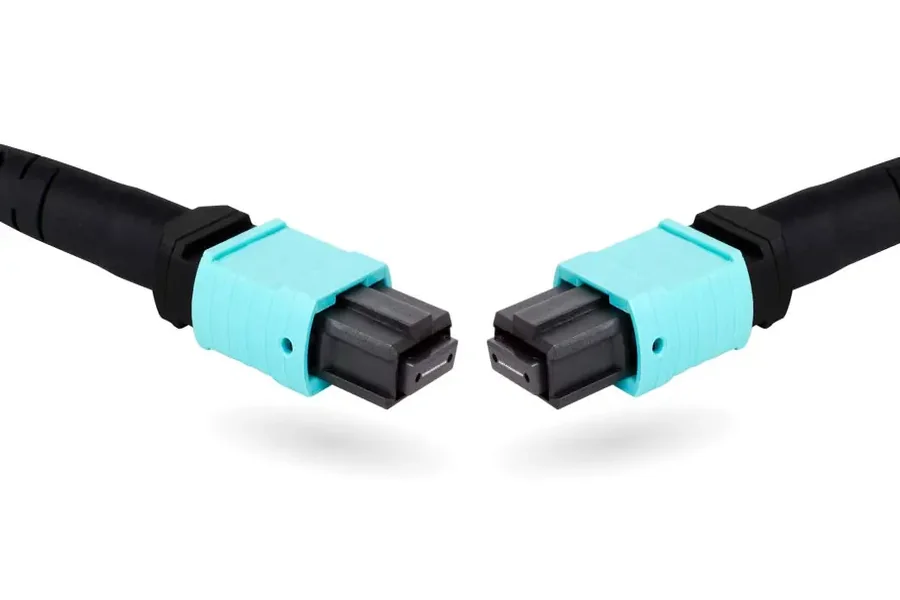
With the rapid expansion of data center networks, 40G optical connectivity has become a fundamental technology for supporting high-bandwidth applications. Among the different 40G transceiver types available on the market, the 40GBASE-PSM4 QSFP+ optical module is widely recognized as an efficient solution for medium- and long-reach transmission. Designed to support distances of up to 10 kilometers over single-mode fiber, this module uses a parallel transmission architecture rather than wavelength division multiplexing. A key characteristic of this design is the use of MPO/MTP connectors instead of traditional duplex LC interfaces.
In modern networking environments, interface selection is just as important as optical performance. The interface determines how the transceiver connects to the fiber cabling system and directly affects installation efficiency, cable management, and scalability. For this reason, most 40G PSM4 transceivers are designed with MPO/MTP interfaces, which are optimized for multi-fiber parallel transmission. This design choice is closely related to the internal architecture of the module and the practical requirements of high-density data center cabling.
As data center operators deploy increasing numbers of high-speed links, the demand for simplified and space-saving connectivity continues to grow. Traditional dual-fiber connections are no longer sufficient for many high-speed scenarios. By combining multi-fiber parallel optics with compact connectors, 40G QSFP+ modules based on PSM4 technology are able to deliver higher efficiency and better scalability. Understanding why MPO/MTP interfaces are used in 40G PSM4 modules helps engineers make smarter decisions when planning network infrastructure.
The Parallel Transmission Architecture of 40G PSM4
How 40G PSM4 Transmits Data
Unlike 40G LR4 or ER4 modules that use WDM technology to transmit four wavelengths over a single fiber pair, the 40GBASE-PSM4 module adopts a parallel single-mode approach. It divides the 40Gbps signal into four independent 10Gbps channels. Each channel is transmitted over a separate optical fiber. As a result, a total of eight fibers are required—four for transmitting and four for receiving.
This parallel transmission structure makes the use of MPO/MTP connectors a natural and logical choice. An MPO/MTP connector is specifically designed to accommodate multiple fibers within a single compact interface. Instead of using four individual LC duplex connectors, which would be bulky and inefficient, the MPO/MTP connector integrates all eight fibers into one unified connection point. This greatly simplifies the physical design of the module and ensures that all channels are properly aligned.
Compatibility Between MPO/MTP and PSM4 Design
The internal optical engine of a 40G PSM4 module is built around a multi-channel architecture. It includes four separate lasers and four separate photodetectors, each corresponding to one optical lane. To maintain this one-to-one relationship between optical lanes and fibers, a multi-fiber connector is required. MPO/MTP connectors provide exactly this capability.
By using a standardized 12-fiber MPO/MTP connector, the module can support the required eight active fibers while leaving additional fibers available for future upgrades or alternative configurations. This structural compatibility is one of the main reasons why MPO/MTP has become the default interface for PSM4 technology. The connector is not just a physical accessory but an integral part of the overall system design.
Advantages of MPO/MTP Interfaces in 40G PSM4 Deployments
High-Density Cabling Efficiency
One of the most significant benefits of MPO/MTP interfaces is their ability to support high-density cabling. In large-scale data centers, hundreds or even thousands of optical links may need to be installed in a limited space. Using traditional duplex LC connectors for every 40G link would quickly lead to overcrowded panels and complex cable management.
MPO/MTP connectors solve this problem by consolidating multiple fibers into a single interface. This allows network administrators to deploy more connections within the same physical footprint. Patch panels, switches, and cabling trays can all be organized more efficiently, reducing clutter and improving airflow. For environments where space is limited and scalability is essential, this advantage is particularly valuable.
Simplified Installation and Maintenance
Another important advantage of MPO/MTP interfaces is the simplicity they bring to installation and maintenance. With a single plug-in action, technicians can connect all eight fibers of a 40G PSM4 link at once. This is far more convenient than handling multiple individual LC connectors, which are more prone to human error.
The standardized design of MPO/MTP cabling systems also makes it easier to perform moves, adds, and changes within the data center. Pre-terminated MPO/MTP trunk cables can be quickly installed without the need for field termination or complex splicing. This reduces deployment time and lowers the risk of installation mistakes. In addition, troubleshooting becomes more straightforward because each 40G link corresponds to a single physical connector.
Future-Proof Scalability
MPO/MTP interfaces provide excellent scalability for future network upgrades. The same cabling infrastructure used for 40G PSM4 can often be reused for higher-speed technologies such as 100G or 400G parallel optics. Because MPO/MTP connectors support multiple fibers, they are well suited for next-generation transceivers that require even more optical lanes.
This future-proof characteristic protects infrastructure investments. Organizations that deploy MPO/MTP-based 40G PSM4 links today can upgrade to higher data rates in the future without replacing their entire cabling system. Such flexibility is a major advantage in fast-evolving data center environments.
Conclusion
The use of MPO/MTP interfaces in 40GBASE-PSM4 QSFP+ optical modules is not a coincidence but a carefully considered design decision. The parallel transmission architecture of PSM4 technology requires multiple optical fibers to operate simultaneously, and MPO/MTP connectors provide the most efficient way to manage these fibers within a compact and standardized form factor.
By enabling high-density cabling, simplified installation, and seamless scalability, MPO/MTP interfaces perfectly match the practical needs of modern data centers. They help reduce complexity, improve operational efficiency, and prepare network infrastructure for future growth. For organizations deploying 40G PSM4 solutions, understanding the advantages of MPO/MTP connectivity is essential for building reliable and manageable high-speed optical networks. Staying informed through trusted resources such as gramernest.com can help IT professionals make better decisions when designing and maintaining modern network infrastructure.